
In an effort to try to make this thing as diverse as my own jumbled-up pate, I’ve tried to post on a few different things. My 1st blog about ghost hunting has been my most popular to date, and with my first investigation after a hiatus coming up next weekend, I’ve got ghosts on the brain. Today, I’ve decided to delve into the technical aspect of p.i. (that’s paranormal investigating to you and me, Russ), literally speaking. We are going to talk about equipment. I’ll give you some basics, examples of what I use and some of the more elaborate versions of the basics. These items would make up your basic ghost hunting kit, in my never-been-so-humble opinion.
- Visual
A good camera is one of the most basic pieces that any ghost hunter should carry. This is the easiest piece of equipment because almost all of you have one in you pocket, on your table, in your hands, etc. The best piece of evidence I ever caught was on the camera of my Droid 2 way back when, and with the cameras that are being installed in phones now, why spend $300 getting a separate comparable camera. (picture included)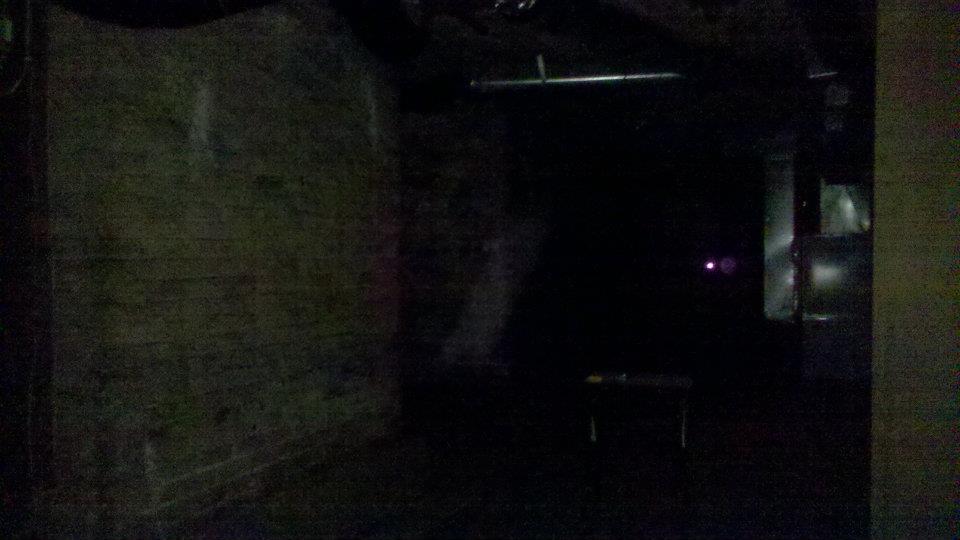
If you like moving pictures, no need in going all out. A good Canon or comparable digital video recorder with IR video is perfectly serviceable. You will need an IR illuminator for this, but those aren’t too pricey either. “But, Aaron, I have unlimited expendable income and want to do this like the guys on TV!” Ok, you can invest in a DVR system complete with a number of stationary IR cameras, tripods and mounts, monitor and recording system. These are really only useful on large investigations, though. I’ve never had any need to buy one, mostly because I hang out with people who already have one. Winning!
- Audio
The most important things to remember when it comes to audio recording (for EVPs and phantom noises) is digital is best for quality and for ease of analysis. There are some people who feel you get better results with tape because of the ambient noise involved. They say it actually lends itself to recording spirit voices, I say it sounds like snow on the TV. Plus, it’s a pain in the ass to have to play the tape into a digital recording program so that you can then load that onto your sound editor for cleaning and enhancing. Why not do digital and plug it directly into your computer and just transfer files? So much easier.
If you really want the best in the business, an omni-directional recorder, like the ZOOM 360° Recorder, offers amazing quality audio with about a $250 price tag. You can also find digital voice recorders that offer real time playback, so you can listen to your recordings as you’re recording them. They also run approximately $250, but they’re pretty cool. I, myself, stick to the basics. I use 2 Olympus VN-722PCs and an RCA VR-5320R. Both have great quality, a ton of record time, and the RCA has a built-in USB that slides right out of the top. External microphones are optional.
- Energy
We measure several different kinds of energy in paranormal investigation: primarily temperature and electro-magnetic frequency, sometimes barometric and even radioactive. I’m only focusing on the common types of temperature and EMF, though. You’ll have to get your radiation kicks elsewhere, you filthy beggars. Temperature can be measured by any thermometer (obviously), but the “industry standard” is the IR temperature gun. It gives you the ability to focus on specific areas and points of interest. The one I use comes with a laser pointer for aiding in aiming and a button to light the screen for working in total darkness. You can also find them with an ambient wand attachment that will measure the temperature around the thermometer also.
For EMFs, there are many types of meters, usually used by electricians, that can measure EMF. For those unversed or uneducated, electro-magnetic energy is given off by everything that involves electricity: appliances, electronics, even people (in extremely small amounts). These meters measure how much of that energy is in the air. If you’re standing in the middle of the room with nothing near you, the baseline reading should be 0.0 to 0.2 milliGauss. Move the meter close to a microwave or electrical outlet, probably closer to a 5.0-8.0. If you’re getting 5.0s in the middle of a room and can’t trace it to a source, that’s not normal, hence paranormal.
I have a Lutron EMF-822A, a basic digital read-out EMF meter. Extech also makes a very similar product. I also own a K II (deluxe edition so you don’t have to stick a quarter in the button to keep it on). The Lutron is used for basic EMF measuring, getting a baseline of the area you’re in and then checking for spikes. The K II can be used for the same thing but it has a much more fun, alternate use. The K II registers EMF with a series of scaling lights to show how strong the energy is. You can use these lights as a form of communication with a formerly living person by asking simple yes or no questions and making the lights or absence of lights correspond with the yes or no answers. It’s amazing to see it happening.
Now you can combine the EMF and thermometer in one device known as a Mel meter, or Mel 8704R. These usually have around a $100 price tag.
As far as cost and ease of access to the equipment, I got all of my equipment for anywhere from $20 to $50 per piece and bought it all from either Radio Shack, Ebay or Amazon. Easy peesy lemon-squeezy. Of course, there’s tons of other stuff out there that you can buy and thousands of people who would love to take your money for this stuff, but if you can measure energy and record audio, video and images, you’re pretty well set. If you have any questions, check with my T A for my office hours.
Oh, and a flashlight. You NEED a flashlight. AND batteries. Lots and lots of batteries.
In the words of Judas Escariot, “Two words: @#$% you, pay me!”
 Fatty Wants His Lunch
Leave a comment